

Address the HOW before the WHAT
Using mindful eating strategies to shift your mindset around food.

As a follow up to my previous nutrition article, today’s topic is a foundational aspect to health and wellness that must be addressed before other more complicated topics arise on Belly Muse. First, I want to make sure this article doesn’t get taken out of context. This article is not meant to address eating disorders, as I am not an expert in this field. Rather it is meant to help the general individual evaluate how their eating behaviors are influencing their health and wellness goals and impacting their gut health. Once you are able to understand, then you can become an educated observer of your own actions. This new awareness can help gradually shift your mindset and behaviors around meal times and hopefully help foster a nurturing relationship with food and therefore also your health.
Although this may come as a surprise, before you address WHAT is on your plate, you should address the HOW. Addressing how you eat can impact your health in many ways. Unfortunately, most of the time this aspect is overlooked or disregarded. Supplements and drastic diet changes usually steal the limelight. But if you have not addressed the HOW, then likely the WHAT, whether supplement or food, is not going to make as big of a difference as you may have hoped.
Being mindful and intuitive is at the core of how you eat. So what is mindful and intuitive eating exactly? It is all about listening to your body’s messaging. Some examples may include: hunger, satiety, and cravings. It’s also about becoming aware of what emotional state you are in, what environment you are in, and how your body is responding to that. Unfortunately, it can be difficult to truly listen when we are constantly distracted, stressed, and on the go. In today’s day and age, it is quite common that we are eating on the run, eating very fast, eating when we are anxious or stressed, skipping meals and replacing them with coffee, and are constantly thinking about the next “thing” that needs to get done. All of this does not contribute to mindful and intuitive eating. Nor does it help with eating in moderation. We are moving too fast to listen to our bodies! We are more “human doings” rather than human beings. Just two hundred years ago humans did not have the luxury to dismiss food as we do now. It took alot of planning, time, and energy to ensure everyone got enough to eat. Whereas today, it is quite the opposite, and for some eating almost seems like an inconvenience in their day. Therefore, in order to become aware of HOW we eat, we must first learn how to slow down so that we can reconnect with our bodies and listen to the messages they are giving us.
To begin, the first question you should ask yourself is “How am I eating?” The examples below are adapted from the Adult Eating Behavior Questionnaire and can help quick start personal reflection. If any of the following questions trigger a negative emotional response, then I would recommend reaching out to a health care provider that can help you personally.
Are you a fast eater? A slow eater?
Do you watch TV or read while you eat?
Do you work while you eat?
Do you skip meals all together?
Are you eating standing up? In the car? While walking?
Do you sit while you eat?
Do you eat alone or with others?
Do you eat when you are sad, happy, bored, or anxious?
Do you really chew your food?
Do you continue to eat when you are already full?
Do you often ignore your hunger?
When you miss a meal do you get hangry?
Do you constantly think about food?
Do you enjoy the foods you eat?
Do you look forward to your meals?
Do you taste every bite you eat?
What are you thinking about when you eat?
Although there are so many more questions that can be asked when trying to determine HOW someone is eating, generally the above are a great starting place. Once you are aware of your eating behaviors and habits, you can modify them to better support your health. The wonderful news is that mindful eating strategies can have lasting benefits to your health as well as your relationship with food. Eating mindfully allows for enhanced digestion and nutrient absorption, reduced stress, increased energy, and overall a better body image. Why? Because it directly addresses mindset and mindset is everything. Implementing mindful eating strategies will increase your wellbeing without even changing the foods you eat. It is free! By simply slowing down and being present, and actually tasting your food, you will eat less, feel more satisfied, have less bloating, and have more energy. Therefore, it is an essential step to energizing your eating pattern. Below I will outline some mindful eating strategies I like to incorporate and also recommend to clients.

Mindful Eating Strategies:
Try sitting down for each meal.
Eating on the go, driving a car, or while walking, disconnects us from our food because we are multi-tasking. Taking the time to sit and eat, rather than eat and react to our surroundings, allows us to become more present in the now. It allows our mind to register that we are in fact “eating”.
Calm your mind before you eat.
If you’re feeling extra anxious from the day’s to do list, then try implementing some deep breathing before you start to eat. Five deep breaths before each meal can help stimulate your ”rest and digest” parasympathetic nervous system. Sometimes I even like to put my feet up against the wall for a few minutes if I am feeling extra frazzled. Both practices help calm down your stress response and allow you to be ready to consume food. Eating while stressed is not a supportive behavior and can lead to digestive discomfort. So anything you can do to help your mind calm down is helpful.
Eat more slowly and enjoy the flavors of your food.
If you are already a slow eater, then skip forward. However, if you are a self-proclaimed fast eater (I will raise my hand too), then this alone will make a drastic difference for you. When we inhale our food, we don't really taste it, smell it, nor truly see it. It comes, it is devoured, and it is gone. Taste, sight, and smell are powerful signals to our nervous system that we are going to eat and/or are eating, and directly helps prime digestion. This is called the cephalic phase. If you are able to slow down, visually accept your meal, taste it, smell it, and enjoy the flavors of your food, your digestion will be fired up more efficiently, leading to less bloating and discomfort. Furthermore, allowing the time for the senses to be activated also plays a big role in “mental” satiety. You feel satisfied and have less hunger for more.
Avoid eating while working.
I know many of us eat while working. I used to do it all the time, especially lunch. However, when we eat while we work we are distracted and often stressed. Both of these lead to a poorly primed digestive tract and blunted senses. Have you ever eaten a meal while working and not even realized that you finished what you had nor do you remember what it tasted like? I know I have! Instead, at the very least, allow yourself 10-15 minutes to eat your lunch and turn away from the computer.
Choose foods that are pleasing as well as nourishing.
Sometimes we can become very focused on making the “healthiest” or “best” choice. For example, just because kale is a nutrient rich food doesn't mean all you should eat is kale. If you don’t like kale, and prefer mixed greens, great! Eat what you like. This is a fundamental value to hold dear to your heart always. The more you enjoy your food, the better you will feel in your belly, mind, and soul. Granted this doesn't mean always choosing processed food over more nutritious whole food, or choosing gluten containing bread if you a gluten sensitivity, rather it is about finding the balance that serves you best. A balance that supports your health, but also doesn't keep you from enjoying food as comfort too. For example, for a long time I avoided burgers and fries because I didnt deam them healthy enough. Now, I thoroughly enjoy a good burger (either homemade or out) and French fries probably 2-3x a month….and savor every bite.
Plate your food like you are at a restaurant.
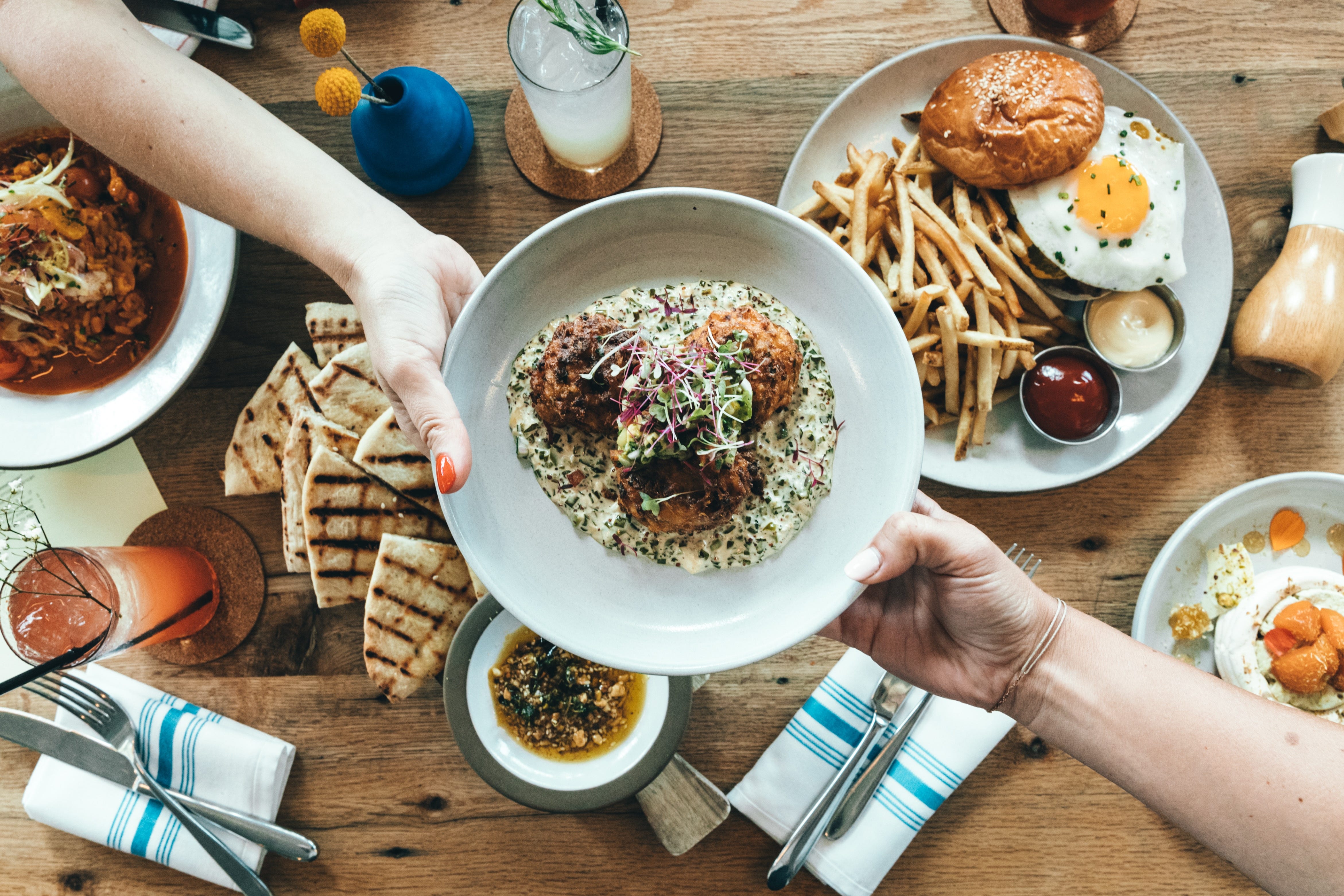
This is my favorite. It works for me like a charm. I enjoy plating my food in a way that is visually attractive and pleasing to the eye. This step alone helps me slow down and activate my senses. I become very aware of what I am going to eat and it starts stimulating my appetite. I honestly do this for every meal because it has become such a deep seeded habit. Try it and let me know what you think.
Avoid skipping meals most days.
A pattern I see often is skipping breakfast. When the mornings are busy and the coffee is flowing, we are distracted and caffeinated, which naturally suppresses hunger, and therefore we often forget or simply choose not to eat. A few hours later when the caffeine wears off and we are settled, then hunger screams. At that point you will eat anything and everything you can get your hands on to calm the hunger. You are responding to an innate need for fuel. This physical and mental state makes it very difficult to make “good” choices, eat slowly, or stop before you are stuffed. Therefore, it’s always important to check in with yourself to see if you are hungry before you get HANGRY.
Honor Your Cravings
Although this strategy can be trickier to implement, and often requires a bit more nutrition know-how, it is an essential aspect to mindful and intuitive eating. I don’t know how many times I have had women tell me that they crave meat leading up to or during their period. Interestingly, red meat is an excellent source of iron and zinc, both important minerals for blood building. Pregnant mamas often report cravings. The most common I have heard include pickles (need for sodium due to an increase in blood volume), bananas (increased need for potassium), eggs (increased need for choline for baby brain development), and cheese (increased need for calcium for baby bone development). If your body is craving a certain food, then ask why? Most of the time it means you need more of something found in that food. However, this is not always fool proof. For example, if you are craving simple carbs and sugar, often the answer is not quite as clear. It could be for a variety of different factors, but one of the most common reasons is blood sugar imbalances due to inadequate protein intake throughout the day. So the answer here is not necessarily eat more simple carbs and sugar, but rather support blood sugar balance throughout the day by eating adequate protein at each meal, including breakfast. This is why working with a dietitian can be helpful to navigate your cravings.

Although often overlooked, or passed by, your relationship with food is vital to your health and wellness goals. Now that I have given you many tools to help you better listen to your body’s cues, and practice mindful eating, I hope you can choose at least one to try yourself. As a mama of two, meal times can be quite stressful. Therefore, I know how difficult it can be to practice mindful eating. However, I still try to incorporate some tools every day, and also give myself grace when I forget to be as mindful as I hoped I would be.
Now, I hope you enjoy your meal…and eat it away from the computer :)
You can do it!
Selva
PS. Please share your daily strategies that help you slow down and practice mindful and intuitive eating.